Meet the mushrooms
Turkey Tail: The Mushroom With the Striped Rings
The short version: Turkey Tail is a thin, striped, fan-shaped mushroom that grows on dead wood almost everywhere in the world. It's one of the most common mushrooms in North American woods, it's too tough to eat like a button mushroom, and it's one of the five mushrooms in every scoop of ChagaRoot MycoProtein.
That's the gist. The longer story has wild turkeys, Japanese roof tiles, a "cloud mushroom," woodworkers who prize what it does to a log, and a simple flip test you can do on your next hike. Pour a coffee. It takes about six minutes.

Why it's called Turkey Tail
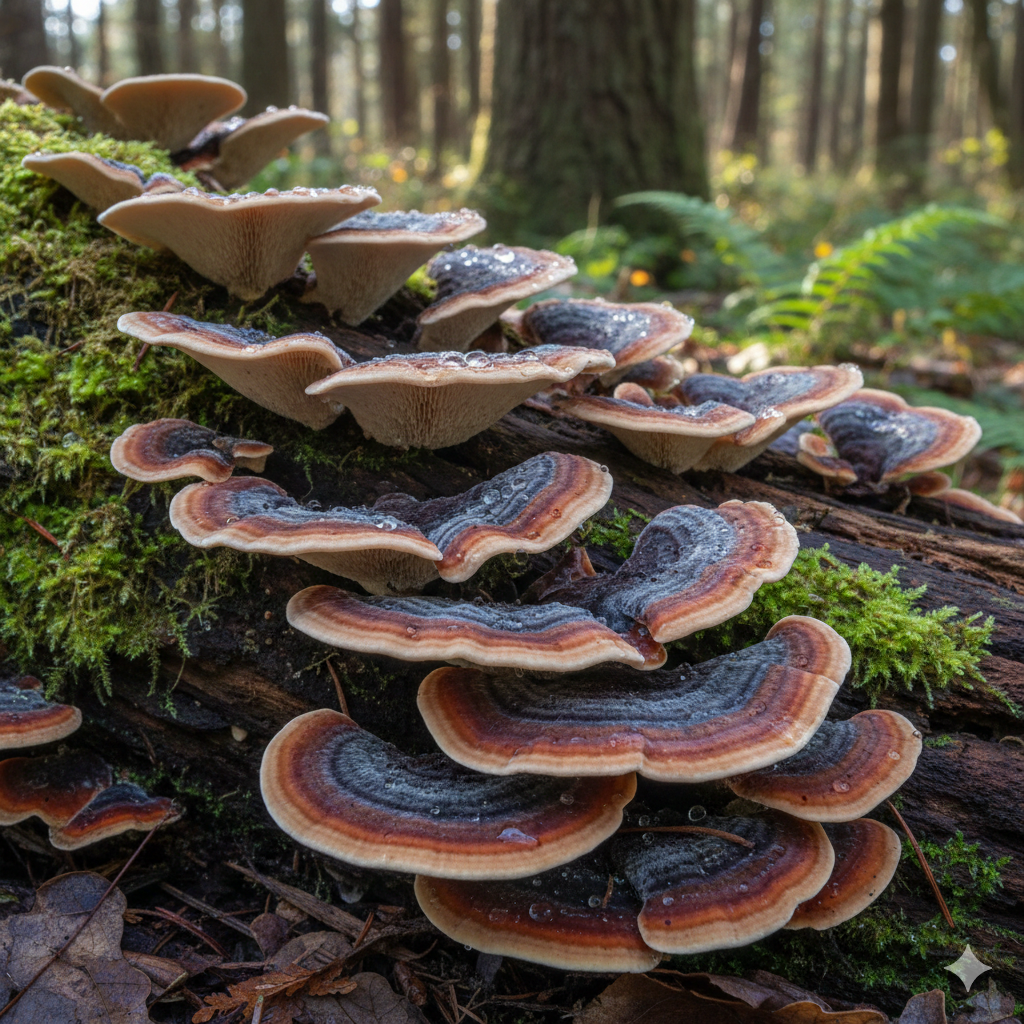
Picture a wild turkey showing off: tail fanned out, feathers striped in bands of brown, tan and copper. Now shrink that fan down to the size of a cookie and stick a few dozen of them on a fallen log. That's Turkey Tail.
Every culture that's noticed this mushroom seems to have named it after something else:
- Scientists call it Trametes versicolor. Versicolor is Latin for "of several colors," and it earns it. Caps can be brown, cinnamon, rust, gray, white, and every so often blue, green or orange.
- In Japan it's kawaratake, the "roof-tile mushroom," because the caps overlap in neat rows like tiles on a traditional roof.
- In China it's yunzhi, usually translated as "cloud mushroom," for the soft, swirling shape of the clusters.
Turkey, roof tiles, clouds. Same mushroom.
How to spot the real thing
Turkey Tail grows year-round, so you can look for it any time you're in the woods. Here's the field guide:
- Check the wood. It grows on dead hardwood: fallen logs, stumps and old branches, and once in a while on conifer wood.
- Look for crowds. It almost never grows alone. Expect dense clusters of overlapping caps, stacked like shingles.
- Look for stripes. The caps have sharp, contrasting rings of color, often with white or gray bands between darker ones.
- Touch it. The top feels velvety, almost like suede. Each cap is only 1 to 2 millimeters thick and usually 2 to 8 centimeters across, and a fresh one bends instead of snapping.
- Flip it over. This is the big one. Real Turkey Tail has tiny pores underneath, about 3 to 5 per millimeter, so the underside looks like a very fine white sponge.
Its best-known look-alike is false turkey tail (Stereum ostrea). From the top, the two can look nearly identical. Underneath, false turkey tail is smooth, like the back of a sheet of paper. A few other close cousins are fuzzier and paler, or stiff and hard instead of bendy.
Flip it over. Tiny pores mean Turkey Tail. Smooth means keep looking.
What Turkey Tail does in the forest
Turkey Tail is a decomposer, and a very good one. It's what scientists call a white rot fungus.
Wood is mostly two things: cellulose, the fibers, and lignin, the tough natural glue that holds those fibers together and makes wood stiff. Very few living things can break lignin down. White rot fungi can. As Turkey Tail's mycelium works through a log, it eats away the dark lignin and leaves behind pale, soft, stringy wood. Given enough time, that log becomes soil.
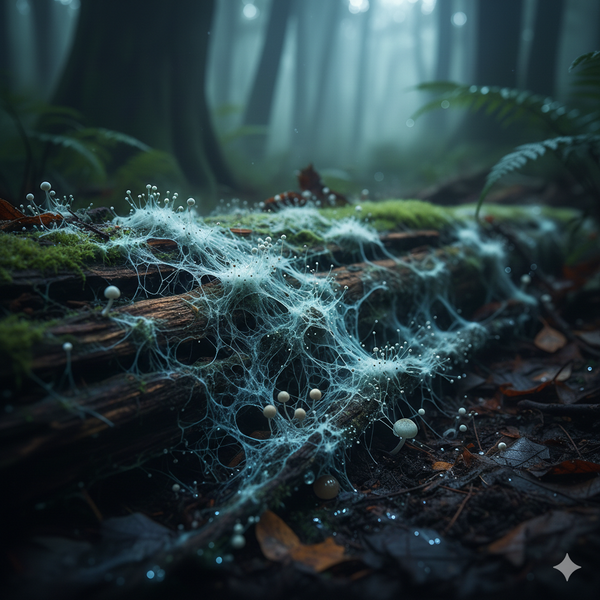
The cap you see is just the fruit. The real work happens inside the wood, in the web of mycelium you never see. (More on that in Mycelium: What It Is and Why It's in Your Protein.)
Woodworkers have a soft spot for it
If you've ever seen a bowl or tabletop with dark ink-like lines and bleached patches running through the grain, you've seen spalted wood. Spalting is the pattern fungi leave behind as they start breaking wood down, and woodworkers prize it.
Turkey Tail is one of the fungi behind the effect. As a quick, efficient white rot of hardwoods, it can leave lighter, bleached-looking areas where its white mycelium is concentrated. Catch the wood at the right moment, before it gets too soft, and a rotting log becomes a one-of-a-kind piece of furniture.
A few more things you might notice
- Green caps. Older Turkey Tail sometimes has green bands. That's often algae growing on the surface, not the mushroom changing color.
- Bugs. Turkey Tail is food for other creatures too, including certain caterpillars, fly maggots and fungus gnats.
- It's everywhere. Turkey Tail is found worldwide. Look on the next fallen log you pass and there's a decent chance you'll find some.
How people use it
Turkey Tail is leathery and tough, so nobody is slicing it into a stir-fry. In China, people have long simmered it into tea. Today it's grown on farms, then dried and ground into powders and blends, which is how it ends up in your scoop.
Turkey Tail in MycoProtein
Here's where it fits. ChagaRoot MycoProtein starts as pea and rice protein, which is fermented with Shiitake mycelium. Then four more mushrooms join in, and Turkey Tail is one of them. We use the fruiting body (the striped caps), and it's 100% sourced in the USA.
And no, it doesn't make your shake taste like mushrooms, or turkey. You taste Chocolate or Vanilla. (For how the whole thing comes together, read What Does MycoProtein Mean?)
Meet Turkey Tail's teammates
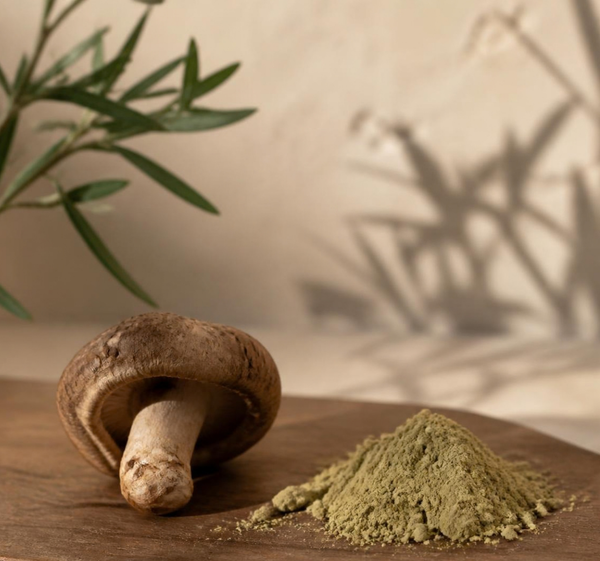
Shiitake. The fermenter. Its mycelium works on the pea and rice protein the way a starter works on sourdough. Cultivated for about 800 years.
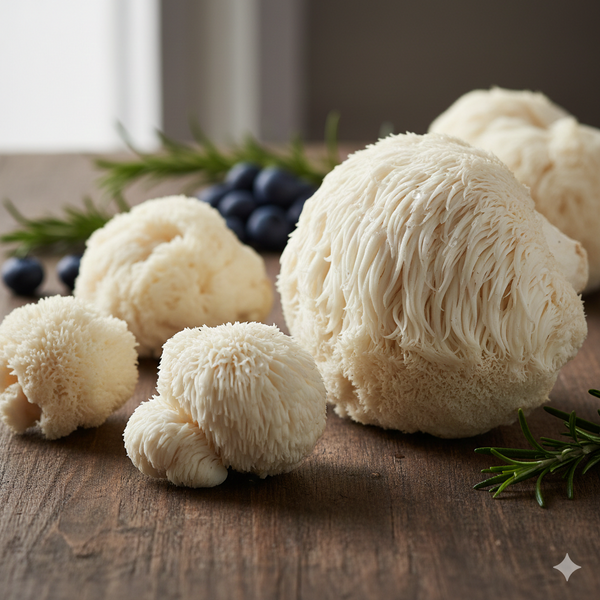
Lion's Mane. Shaggy white spines instead of a cap, like a frozen waterfall on the side of a hardwood tree. More on Lion's Mane.
Reishi. A glossy, reddish-brown shelf mushroom that looks like it's been lacquered. Like Turkey Tail, it's too woody to eat sliced.
Chaga. Our namesake. A black, cracked lump on birch trees that looks like burnt charcoal. More on Chaga.
What's in a scoop
- 20g of plant protein in Chocolate, 19g in Vanilla, per 2-scoop serving
- A complete protein, with a PDCAAS (Protein Digestibility-Corrected Amino Acid Score) of 1.0, the highest score possible
- Five mushrooms: Shiitake, Lion's Mane, Reishi, Turkey Tail and Chaga, all 100% USA-sourced
- Sweetened only with monk fruit and allulose. No stevia, no sucralose, no added sugar and no artificial sweeteners.
- Vegan, gluten free and non-GMO
Common questions
Can I eat Turkey Tail I find on a hike?
We'd leave it on the log. It's too tough to eat like a regular mushroom, and look-alikes are common. Never eat a wild mushroom unless an expert has identified it. The Turkey Tail in MycoProtein is farm-grown and dried.
Is false turkey tail the same thing?
No. It's a different fungus (Stereum ostrea) that looks similar from the top. Flip it: Turkey Tail has pores underneath, and false turkey tail is smooth.
Why do the colors vary so much?
That's the "versicolor" part. Turkey Tail naturally comes in a wide range of browns, grays and whites, with the occasional blue or orange, and older caps can pick up green from algae.
Is MycoProtein vegan?
Yes. Mushrooms are fungi, not animals. MycoProtein is vegan, gluten free and non-GMO.
Try it
Shake it with milk, blend it into a smoothie or bake it into muffins. A few to start with: Chocolate Peanut Butter Banana Smoothie, Protein Pumpkin Muffins, or browse all our recipes.
Curious how it stacks up against whey, plant and pea protein? See how MycoProtein compares. Want to meet all five mushrooms side by side? Head to Mushroom 101. Ready to try it? Shop MycoProtein in Chocolate or Vanilla.
*These statements have not been evaluated by the Food and Drug Administration. This product is not intended to diagnose, treat, cure, or prevent any disease.