Meet the mushrooms
Chaga: The Mushroom That Looks Like Burnt Charcoal
The short version: Chaga is the black, cracked lump that grows on birch trees in cold northern forests. It looks like burnt charcoal, it isn't a mushroom cap at all, and it's the mushroom our name comes from. It's also one of the five mushrooms in every scoop of ChagaRoot MycoProtein.
That's the gist. The longer story has a word borrowed from the Komi people of Russia, a fungus that spends decades on a single tree, a secret orange center, a Finnish tea named after a woodpecker, and a fire starter used for generations. Pour a coffee. It takes about six minutes.

It doesn't look like a mushroom
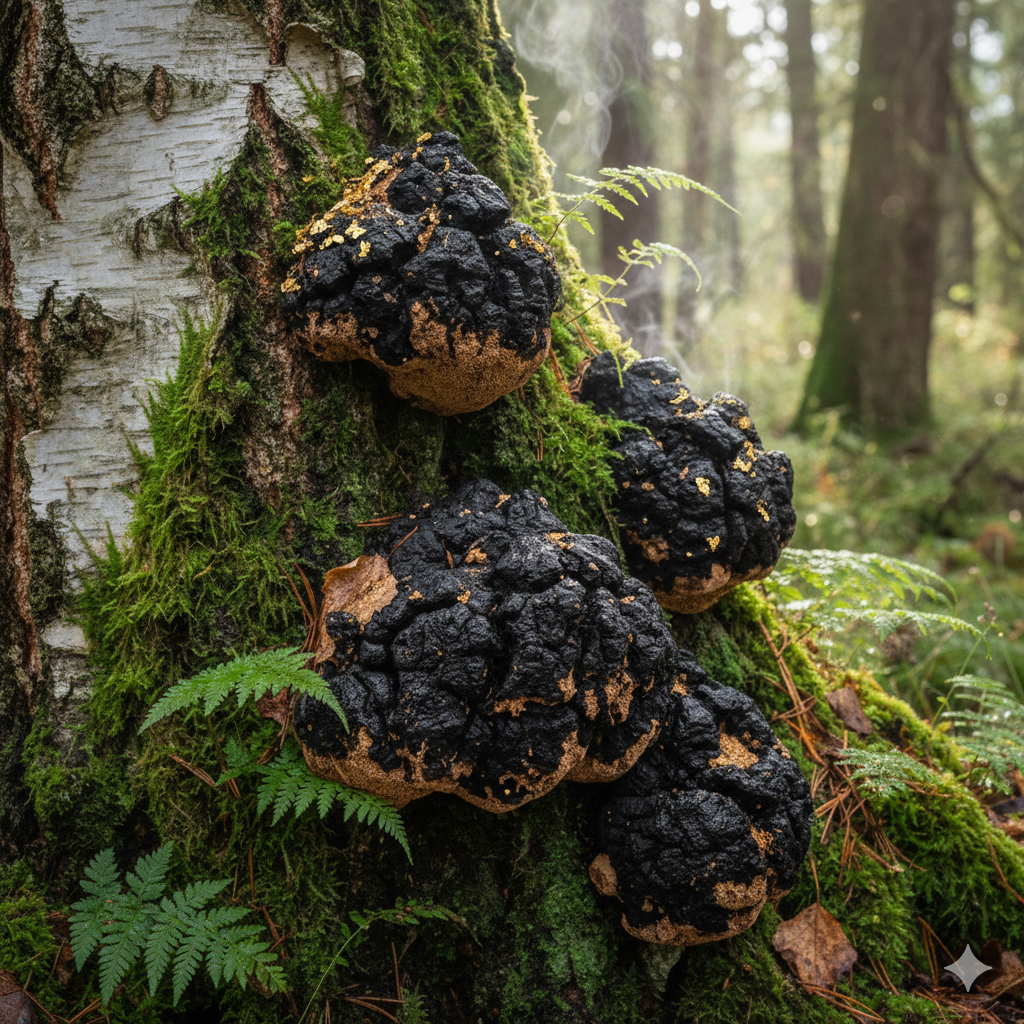
Walk through a birch forest and look for the white trunks. Every so often you'll see a dark, rough knot bulging from the bark, like someone stuck a chunk of burnt charcoal to the tree. That's Chaga.
- The outside is black, hard and cracked into rough little cubes, a lot like a burnt log in a campfire. The black comes from melanin, the same kind of pigment that colors skin and hair.
- The inside is a surprise. Break a piece open and it's a bright, rusty orange-brown, tough and woody, like cork.
- The size can be anything from a fist to a basketball. Large ones reach about 30 centimeters (a foot) across.
So what is it, exactly?
Here's the strange part. That black lump isn't a mushroom in the way you'd picture one. There's no cap, no stem and no gills. It's a sterile conk (scientists also call it a sclerotium): a dense, hardened mass of mycelium, the thread-like body of the fungus, packed tight and pushed out through the bark.
Think of an iceberg again, but flipped. With most fungi, the mycelium hides and the mushroom shows. With Chaga, the mycelium is the part you see. (More on that idea in Mycelium: What It Is and Why It's in Your Protein.)
Its scientific name is Inonotus obliquus. Its common name comes from the Russian chaga, which was borrowed from the Komi word tšak, meaning simply "mushroom." The Komi are an Indigenous people living west of the Ural Mountains.
A life spent on one tree
Chaga's whole story plays out on a single tree, and it takes a long time.
- It gets in through a wound. Spores enter the tree through damage in the bark, often an old broken branch stub that never healed well.
- It grows slowly. The fungus spreads inside the living trunk, slowly decaying the wood for anywhere from 10 to more than 80 years. Along the way, the black conk pushes out through the bark.
- It fruits at the very end. Only after the tree (or that part of it) dies does Chaga form its true fruiting body: a whitish patch that turns brown, hidden under the bark. Because it's hidden, almost nobody ever sees it.
Black as charcoal on the outside, bright orange on the inside, and decades in the making. Chaga is the odd one out, and it's the one we named ourselves after.
Where it grows
Chaga loves the cold. It's most common in the birch forests that ring the top of the Northern Hemisphere: Russia, Scandinavia, Canada, Alaska and the northern United States. In North America, it grows mostly on paper birch and yellow birch, and once in a while on alder, beech or poplar.
Chaga vs. a birch burl
New foragers often mix up Chaga with a burl, a rounded growth of the tree's own wood. Here's the quick test:
- A burl is covered in bark, just like the rest of the trunk, and it's plain wood inside.
- Chaga is black, cracked and crusty, with no bark over it, and it's orange-brown inside.
Tea, fire and a woodpecker
Chaga is far too hard to cook, so people found other uses for it.
- Tea. In Russia and across northern Europe, people have long broken Chaga into chunks or grated it into powder, then simmered it into a dark, earthy tea. Fans say the chunks can be reused for more than one pot.
- Wartime tea in Finland. During World War II rationing, Chaga tea became especially popular in Finland. There it's sometimes called tikka tea. Tikka is Finnish for "woodpecker," a nod to how Chaga, like a woodpecker, works its way into trees.
- Fire. Dry Chaga catches a spark and holds an ember. The Potawatomi people use it as tinder and call it shkitagen.
Today you'll find Chaga in teas, coffees, powders and blends, and in one protein powder named after it.
Why we're named ChagaRoot
For a long time, mushrooms and protein lived in different aisles. You had your protein powder, and you had your mushroom blends, and they didn't mix. ChagaRoot was built to bring them together, and we named the brand after the strangest, most northern, most stubborn mushroom of the bunch.
Chaga in MycoProtein
ChagaRoot MycoProtein starts as pea and rice protein, fermented with Shiitake mycelium. Then four more mushrooms join in, and Chaga is one of them. Ours is Chaga mycelium, and like every mushroom in MycoProtein, it's 100% sourced in the USA.
And no, your shake won't taste like a birch tree. You taste Chocolate or Vanilla. (For how it all comes together, read What Does MycoProtein Mean?)
Meet Chaga's teammates
Shiitake. The fermenter. Its mycelium works on the pea and rice protein the way a starter works on sourdough.
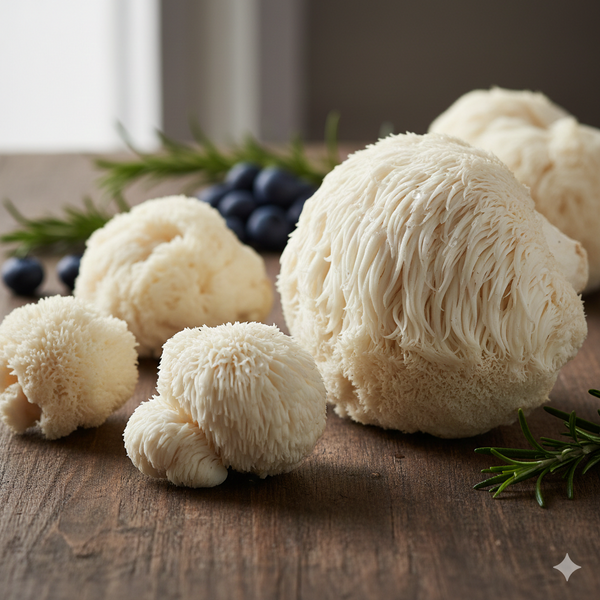
Lion's Mane. Shaggy white spines instead of a cap, like a frozen waterfall on the side of a hardwood tree. More on Lion's Mane.
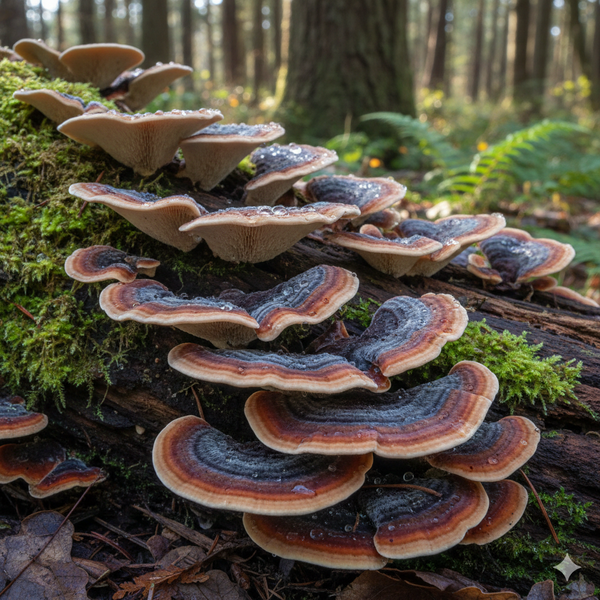
Reishi. A glossy, reddish-brown shelf mushroom that looks like it's been lacquered.
Turkey Tail. Thin, fan-shaped caps striped like a turkey's tail feathers. More on Turkey Tail.
What's in a scoop
- 20g of plant protein in Chocolate, 19g in Vanilla, per 2-scoop serving
- A complete protein, with a PDCAAS (Protein Digestibility-Corrected Amino Acid Score) of 1.0, the highest score possible
- Five mushrooms: Shiitake, Lion's Mane, Reishi, Turkey Tail and Chaga, all 100% USA-sourced
- Sweetened only with monk fruit and allulose. No stevia, no sucralose, no added sugar and no artificial sweeteners.
- Vegan, gluten free and non-GMO
Common questions
Is Chaga a mushroom?
It's a fungus, but the part you see isn't a mushroom cap. It's a hardened mass of mycelium. Chaga's true fruiting body forms later, hidden under the bark.
Does Chaga hurt the tree?
Over time, yes. It slowly decays the wood of a living birch, often over decades, and fruits after the tree dies.
Can I harvest Chaga myself?
Check local rules and get the landowner's permission first, and make sure you've identified it correctly (remember the burl test).
Is MycoProtein vegan?
Yes. Mushrooms are fungi, not animals. MycoProtein is vegan, gluten free and non-GMO.
Try it
Chaga's home is the cold north, so lean into cozy: Protein Hot Cocoa, a Protein Mocha or Chocolate Overnight Oats. Or browse all our recipes.
Curious how it stacks up against whey, plant and pea protein? See how MycoProtein compares. Want to meet all five mushrooms side by side? Head to Mushroom 101, or read our story. Ready to try it? Shop MycoProtein in Chocolate or Vanilla.
*These statements have not been evaluated by the Food and Drug Administration. This product is not intended to diagnose, treat, cure, or prevent any disease.