Meet the mushrooms
Mycelium: What It Is and Why It's in Your Protein
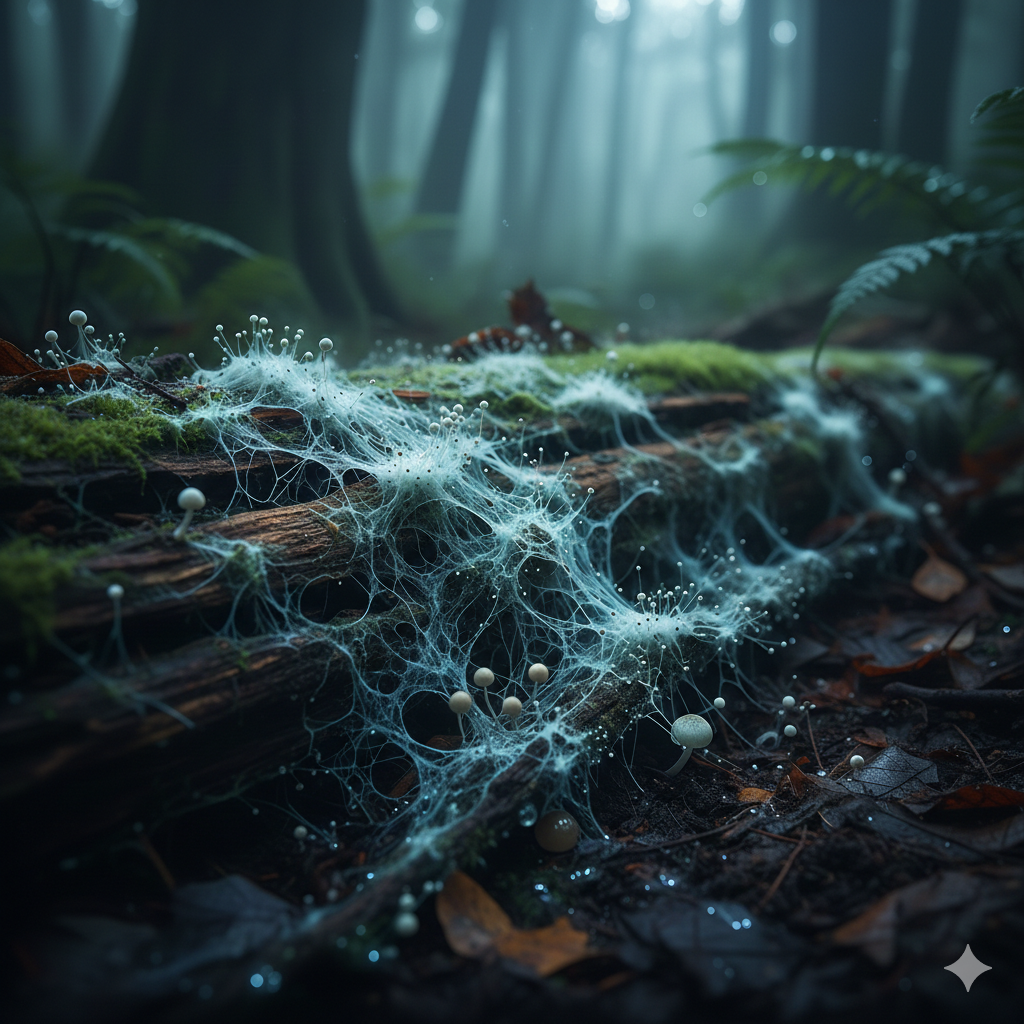
The short version: Mycelium is the part of a mushroom you never see. It's a web of thread-thin filaments running through soil and wood, and it's the living fungus itself. The mushroom is just the fruit it sends up. In ChagaRoot MycoProtein, Shiitake mycelium is what ferments the protein.
That's the gist. The longer story has a fungus bigger than 1,300 soccer fields, 400-million-year-old fossils, a "national fungus," and a packaging company that grows its boxes. Pour a coffee. It takes about six minutes.

What is mycelium, exactly?
Picture an iceberg. The bit poking out of the water is the part everyone notices, but most of it is underneath. A mushroom is the tip of the iceberg. Mycelium is everything below.
Up close, mycelium is made of tiny tubes called hyphae, each one far thinner than a human hair. They grow from their tips, branch, and branch again, until they form a connected web through whatever the fungus is living in: soil, a fallen log, a bag of grain.
- Mycelium is the organism. It eats, grows and spreads, often for years.
- The mushroom (scientists say "fruiting body") is the part that pops up when conditions are right, to release spores. Then it's gone.
Pick a mushroom and the fungus barely notices, the same way an apple tree carries on after you take an apple.
How mycelium eats
Fungi don't make food from sunlight like plants do, and they don't swallow food like animals do. They do something stranger: they digest from the outside.
Hyphae release enzymes into whatever they're growing through, break it down into small pieces, and absorb what they need. Fallen leaves, dead wood, old roots: mycelium turns them back into soil. Without fungi, forests would be buried in their own debris. That makes mycelium one of nature's great recyclers, and it's the same talent that makes fungi so good at fermentation.
The biggest living thing you've never seen
In the Malheur National Forest in eastern Oregon, there's a honey mushroom (Armillaria ostoyae) whose mycelium spreads under about 2,385 acres of forest, roughly the size of 1,350 soccer fields. Guinness World Records lists it as the world's largest fungus and estimates it's at least 2,400 years old, possibly as old as 8,650.
Walk through that forest and you'd never know. Most of the year, all you'd see are trees. The fungus is underground, quietly spreading one thread at a time.
The "wood wide web"
Many fungi team up with plants. Their mycelium wraps around or grows into plant roots, and the two trade: the plant shares sugars it makes from sunlight, and the fungus brings back water and minerals from the soil. This partnership is called mycorrhiza (Greek for "fungus root"), and most land plants have it.
It's also very old. Fossils in the Rhynie chert, a rock bed in northern Scotland roughly 400 million years old, show fungi living inside the stems of some of the earliest land plants.
In 1997, forest ecologist Suzanne Simard and her colleagues published research in the journal Nature suggesting carbon could move between different tree species through these shared fungal networks. The idea caught on, along with a catchy nickname: the "wood wide web." Scientists are still debating how much trees actually share through it, but one thing isn't in question: underneath most forests, there's a lot of mycelium.
Mycelium in your kitchen
You've almost certainly eaten food made with mycelium. A few examples:
- Tempeh. A fungal culture grows its white mycelium right through cooked soybeans and knits them into a firm cake. It comes from the Indonesian island of Java.
- Koji. A mold grown on steamed rice or soybeans, behind miso, soy sauce and sake. It's so central to Japanese food that in 2006 the Brewing Society of Japan named it the country's "national fungus."
- Shiitake logs. Shiitake growers drill holes in hardwood logs and plug them with mycelium. It spends months spreading through the wood before the first mushrooms appear.
- Store-bought mushrooms. Look at the bottom of a mushroom stem and you'll sometimes see fuzzy white threads. That's mycelium.
Mycelium beyond the kitchen
Because mycelium grows into whatever shape it's given and binds loose material together, people are building with it. In 2007, two Rensselaer Polytechnic Institute grads, Eben Bayer and Gavin McIntyre, founded Ecovative, a company that grows mycelium through farm leftovers to make compostable packaging, a replacement for foam. Designers have since used mycelium for leather-like textiles, insulation panels and even bricks.
The mushroom gets the attention. The mycelium does the work. That's true in the forest, and it's true in our protein.
Why mycelium is in your protein
Here's where it all comes together. ChagaRoot MycoProtein starts as pea and rice protein. Then we add Shiitake mycelium and let it ferment the protein, a lot like a starter works on sourdough bread. The mushroom becomes part of the protein instead of sitting next to it.
After that, four more mushrooms join in, for five in every scoop, all 100% sourced in the USA. (For the full story behind the name, read What Does MycoProtein Mean?)
Meet the mushrooms in every scoop
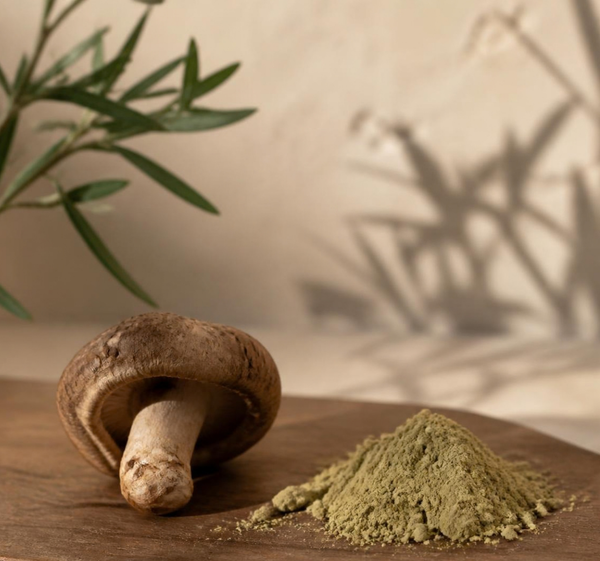
Shiitake mycelium. The fermenter. In the wild, Shiitake grows on fallen hardwood like oak and chestnut, and it's been cultivated for about 800 years.
Chaga. Our namesake, and a mycelium story all on its own. The black, cracked lump you see on a birch tree isn't a mushroom cap. It's a dense mass of mycelium. More on Chaga.
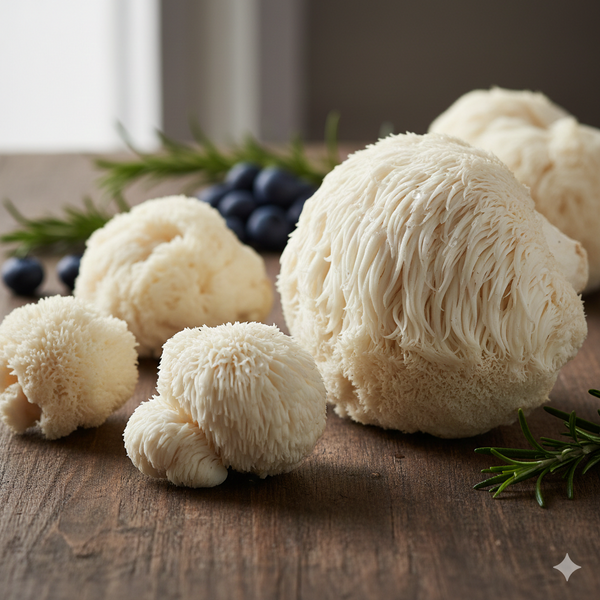
Lion's Mane. Shaggy white spines instead of a cap, like a frozen waterfall on the side of a hardwood tree. More on Lion's Mane.
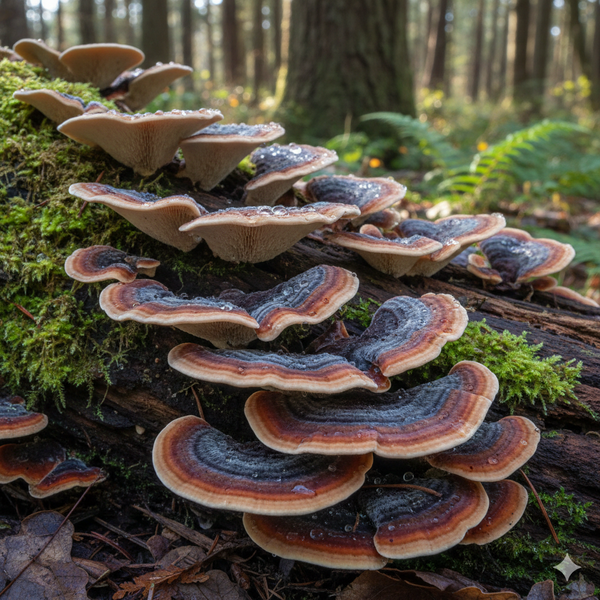
Reishi. A glossy, reddish-brown shelf mushroom that looks lacquered. Too woody to slice into dinner, so it's dried and powdered.
Turkey Tail. Thin, fan-shaped caps striped like a turkey's tail feathers. More on Turkey Tail.
What's in a scoop
- 20g of plant protein in Chocolate, 19g in Vanilla, per 2-scoop serving
- A complete protein, with a PDCAAS (Protein Digestibility-Corrected Amino Acid Score) of 1.0, the highest score possible
- Five mushrooms: Shiitake, Lion's Mane, Reishi, Turkey Tail and Chaga, all 100% USA-sourced
- Sweetened only with monk fruit and allulose. No stevia, no sucralose, no added sugar and no artificial sweeteners.
- Vegan, gluten free and non-GMO
Common questions
Is mycelium a mushroom?
It's the same organism. Mycelium is the fungus itself, and the mushroom is the fruit it grows to spread spores.
Is mycelium the same as mold?
"Mold" is an everyday name for fungi you can see growing as fuzzy mycelium, like on old bread. Lots of fungi grow as mycelium, including the ones in tempeh, koji and your favorite mushrooms. Shiitake mycelium is a food-grade culture, grown on purpose.
Can I see mycelium in real life?
Yes. Roll over a rotting log or dig into damp leaf litter and look for white or cream-colored threads. That's it.
Is MycoProtein vegan?
Yes. Fungi aren't animals, even if they're closer cousins than plants are. MycoProtein is vegan, gluten free and non-GMO.
How people use it
Shake it with milk, blend it into a smoothie, stir it into overnight oats, or bake it into muffins. A few to start with: Pumpkin Protein Overnight Oats, The Smoothest MycoProtein Shake, or browse all our recipes.
Curious how it stacks up against whey, plant and pea protein? See how MycoProtein compares. Want to meet all five mushrooms in more detail? Head to Mushroom 101. Ready to try it? Shop MycoProtein in Chocolate or Vanilla.
*These statements have not been evaluated by the Food and Drug Administration. This product is not intended to diagnose, treat, cure, or prevent any disease.