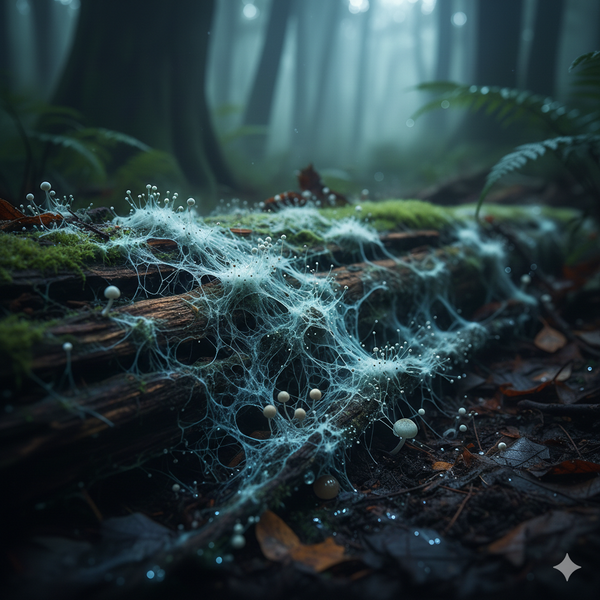
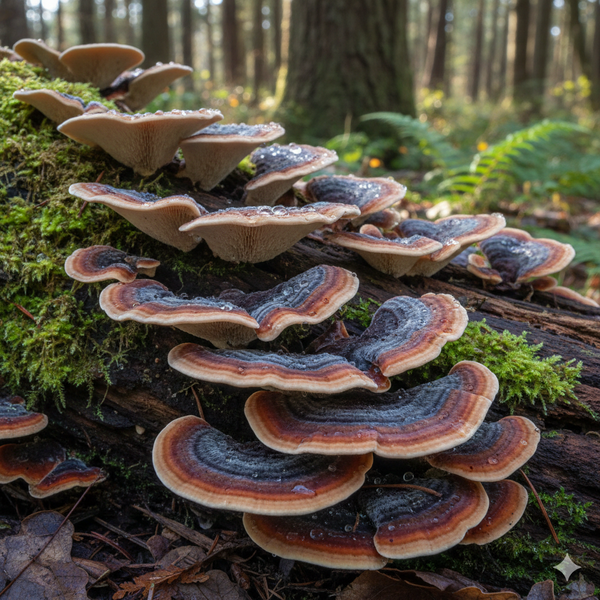
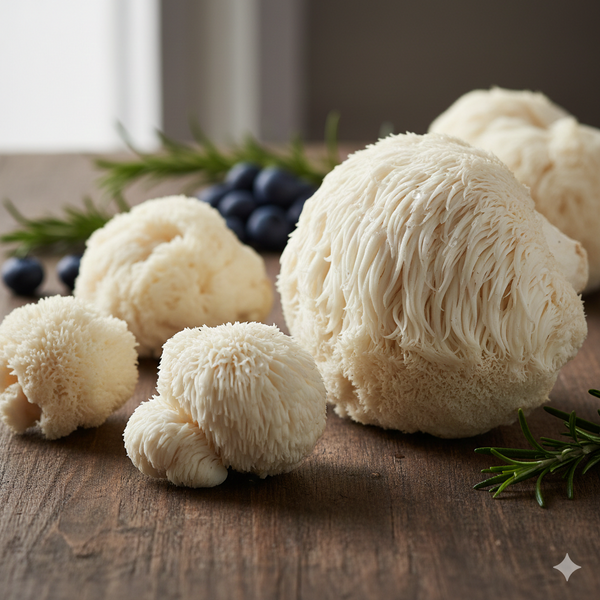
Meet the mushrooms
Functional Mushrooms, Explained (Without the Hype)
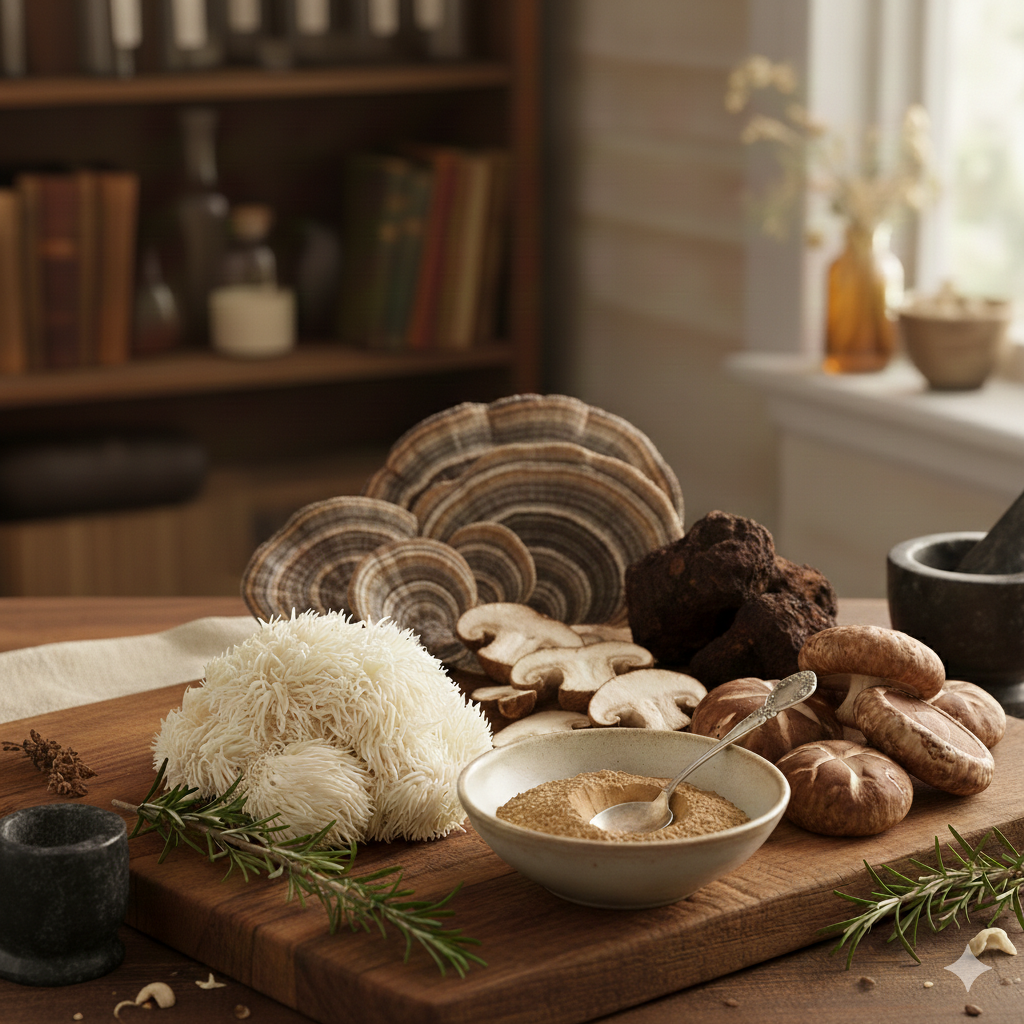
The short version: "Functional mushroom" is an everyday label, not a scientific or legal category. People use it for mushrooms that get used for more than dinner: brewed into tea, dried into powders, or blended into coffee, chocolate and protein. ChagaRoot MycoProtein has five of them in every scoop.
That's the gist. The longer story has a 5,000-year-old iceman, a "divine mushroom" in Chinese art, a mushroom that grows antlers, and the real reason so many labels have a little asterisk. Pour a coffee. It takes about six minutes.

Where the term comes from
You won't find "functional mushroom" in a biology textbook. It's borrowed from a bigger idea: functional food, a term first used in Japan in the 1980s for foods people eat for reasons beyond basic nutrition.
In the U.S., "functional food" has no legal definition, and the FDA doesn't treat it as its own category. Depending on what's in a product and how it's sold, the FDA regulates it as a regular food, a dietary supplement or a drug. So when you see "functional mushroom" on a label, read it like "gourmet" or "artisan": it tells you how a product is being positioned, not what's inside.
What it isn't
- Not "magic" mushrooms. Psychoactive mushrooms are a different group, mostly from the genus Psilocybe, and their effects come from a compound called psilocybin. None of the mushrooms in MycoProtein are psychoactive.
- Not always something you'd cook. Some functional mushrooms are great in a pan, like Shiitake and Lion's Mane. Others, like Reishi, Turkey Tail and Chaga, are as tough as wood. Those get dried, ground or brewed.
- Not new. People have been carrying, brewing and trading mushrooms for thousands of years.
People have been doing this for 5,000 years
In 1991, hikers in the Alps found a man preserved in the ice. Scientists nicknamed him Ötzi, and he lived more than 5,000 years ago, around 3300 BC. Among the things he carried were two kinds of polypore mushrooms threaded onto leather strings. One was a tinder fungus, part of his fire-starting kit. The other was a birch polypore, which researchers think he probably carried for a reason other than food.
Mushrooms show up all through history after that:
- China, 1209. The earliest known written record of growing Shiitake comes from the Records of Longquan County, written during the Song dynasty.
- Chinese art. Reishi, known in China as lingzhi ("divine mushroom"), became a symbol of good fortune and long life. You'll find it carved, painted and woven into designs in places like Beijing's Forbidden City and Summer Palace.
- Russia and northern Europe. People grated Chaga off birch trees and simmered it into a dark, earthy tea.
- East Asia. Turkey Tail, called yunzhi in China, has long been simmered into tea.
Meet the five in your scoop
Shiitake. The fermenter. Its name in Japanese comes from shii, a tree whose logs it was traditionally grown on, plus take, "mushroom." Today Shiitake makes up roughly a quarter of all the mushrooms grown in the world. In MycoProtein, its mycelium ferments our pea and rice protein. More on mycelium.
Lion's Mane. No cap, no gills, just a waterfall of soft white spines. Cooks love it for its crab-like texture. More on Lion's Mane.
Reishi. The lacquered one. Its scientific name, Ganoderma, comes from Greek words meaning "shining skin," and its reddish-brown, kidney-shaped cap really does look varnished. Grow it in the wrong conditions, with too much carbon dioxide in the air, and it skips the cap entirely and grows long, branching "antlers." Most Reishi today has been farm-grown since the 1970s, on hardwood logs or sawdust.
Turkey Tail. Thin, fan-shaped caps striped like a turkey's tail feathers, found on fallen logs almost everywhere. More on Turkey Tail.
Chaga. Our namesake. A black, cracked lump on birch trees that looks like burnt charcoal and is bright orange inside. More on Chaga.
"Functional" tells you how a mushroom gets used, not what's in the bag. Skip the hype on the front. Read the label on the back.
How to read a mushroom label
Here's a quick checklist for any mushroom product, ours included:
- Which part of the mushroom? Fruiting body (the part you'd see on a tree), mycelium (the root-like threads), or both. A good label tells you.
- Where is it grown? Look for a country of origin, not just "imported."
- What else is in it? Read the full ingredient list, not the front of the bag. Watch for sweeteners and fillers.
- How much of each mushroom? "Contains mushrooms" can mean a lot or a pinch. Some brands list amounts; it's worth checking.
- What does the asterisk say? See below.
What's with the little asterisk?
If you've ever seen a star after a line on a supplement label and a tiny paragraph at the bottom, here's what's going on.
Under U.S. rules for dietary supplements, a company can describe how an ingredient relates to the body's normal structure or function without getting FDA approval first. When it does, the label must include this exact disclaimer: "These statements have not been evaluated by the Food and Drug Administration. This product is not intended to diagnose, treat, cure, or prevent any disease."
So the asterisk is a signal: the line next to it is the company's statement, not the FDA's. We'd rather tell you what our mushrooms are, where they come from and how we use them, and let the label do the rest.
Our label, in plain English
- Which part: Shiitake mycelium ferments the protein. Lion's Mane, Reishi and Turkey Tail are fruiting bodies. Chaga is mycelium.
- Where: All five mushrooms are 100% USA-sourced.
- Everything else: The full ingredient list is right on the product page.
What's in a scoop
- 20g of plant protein in Chocolate, 19g in Vanilla, per 2-scoop serving
- A complete protein, with a PDCAAS (Protein Digestibility-Corrected Amino Acid Score) of 1.0, the highest score possible
- Five mushrooms: Shiitake, Lion's Mane, Reishi, Turkey Tail and Chaga, all 100% USA-sourced
- Sweetened only with monk fruit and allulose. No stevia, no sucralose, no added sugar and no artificial sweeteners.
- Vegan, gluten free and non-GMO
Common questions
Is "functional mushroom" a regulated term?
No. It's an everyday label. In the U.S., the FDA regulates products by what they are and how they're sold (food, supplement or drug), not by the word "functional."
Are functional mushrooms psychoactive?
No. The five in MycoProtein are not "magic" mushrooms. Psychoactive mushrooms are a different group that contains psilocybin.
Can I just cook with these mushrooms instead?
Some of them, yes. Shiitake and Lion's Mane are great in the kitchen. Reishi, Turkey Tail and Chaga are too tough to eat sliced, which is why they're usually dried, ground or brewed.
Will MycoProtein taste like mushrooms?
No. You taste Chocolate or Vanilla. (For how it all comes together, read What Does MycoProtein Mean?)
Try it
The easiest way to use mushrooms is to fold them into something you already do every day. A few to start with: The Smoothest MycoProtein Shake, Protein Mocha, Chocolate Overnight Oats, or browse all our recipes.
Curious how it stacks up against whey, plant and pea protein? See how MycoProtein compares. Want to meet all five mushrooms side by side? Head to Mushroom 101. Ready to try it? Shop MycoProtein in Chocolate or Vanilla.
*These statements have not been evaluated by the Food and Drug Administration. This product is not intended to diagnose, treat, cure, or prevent any disease.