MycoProtein 101
Why the Future of Protein Might Be Growing on a Log
The short version: Fungi are showing up all over the future of food, from fermented proteins to foods grown from a microbe found in a Yellowstone hot spring. They grow indoors, all year, on things like sawdust and grain, and they're very good at changing whatever they grow on. ChagaRoot MycoProtein puts that talent to work on plain pea and rice protein.
That's the gist. The longer story has a kingdom that's closer to us than to plants, three very different kinds of fermentation, a NASA-funded hunt for life in extreme places, and an oak log with a few dozen holes drilled in it. Pour a coffee. It takes about six minutes.

The big protein question
There were about 8.2 billion people on Earth in 2024. The United Nations projects that number will peak around 10.3 billion in the mid-2080s. That's a lot more breakfasts, and a lot more protein.
This isn't a new worry. Back in the 1960s, food scientists were already asking where the world's next protein would come from, and one of the answers they found was a fungus. (That story is in What Does MycoProtein Mean?) Sixty years later, fungi are back at the center of the conversation.
First, fungi aren't plants
It's easy to file mushrooms next to the carrots in the produce aisle. Biologically, though, fungi are their own kingdom, and they're more closely related to animals than to plants. Fungi and animals sit together in a group called the opisthokonts, named for a shared trait: their swimming cells (in the species that have them) push themselves along with a single tail at the back.
Fungi also eat more like we do than like plants. They don't make food from sunlight. They break down what they grow on and absorb it, which is exactly why they're so useful in a kitchen. (More on that in Mycelium: What It Is and Why It's in Your Protein.)
Three ways fungi make protein
When people talk about "fermented protein," they can mean three very different things. The Good Food Institute, a nonprofit that tracks alternative proteins, sorts them like this:
- Traditional fermentation. A living culture changes a food's flavor or texture. Think bread, cheese, miso and tempeh. The fungus is the cook.
- Biomass fermentation. The fungus grows fast and becomes the food. Quorn, made from a fungus grown in large tanks, is the best-known example. The fungus is the crop.
- Precision fermentation. A microbe is set up to produce one specific ingredient, like a particular protein, enzyme or fat. The fungus is the factory.
ChagaRoot MycoProtein is closest to the oldest of the three: a living culture, Shiitake mycelium, works on plant protein and changes it, the way a starter changes dough into sourdough. Then we add four more mushrooms.
A fungus from a Yellowstone hot spring
Some of the most interesting fungi for food have come from strange places. In 2009, a NASA-funded study of life in extreme environments, meant to help prepare for the search for life on other planets, turned up a fungus living in the geothermal springs of Yellowstone National Park. That fungus, a Fusarium strain, has since been developed into foods like dairy-free spreads and breakfast patties.
A hot spring, a space-research program and a breakfast sandwich. That's the kind of thing that happens when you start paying attention to fungi.
And then there's the log
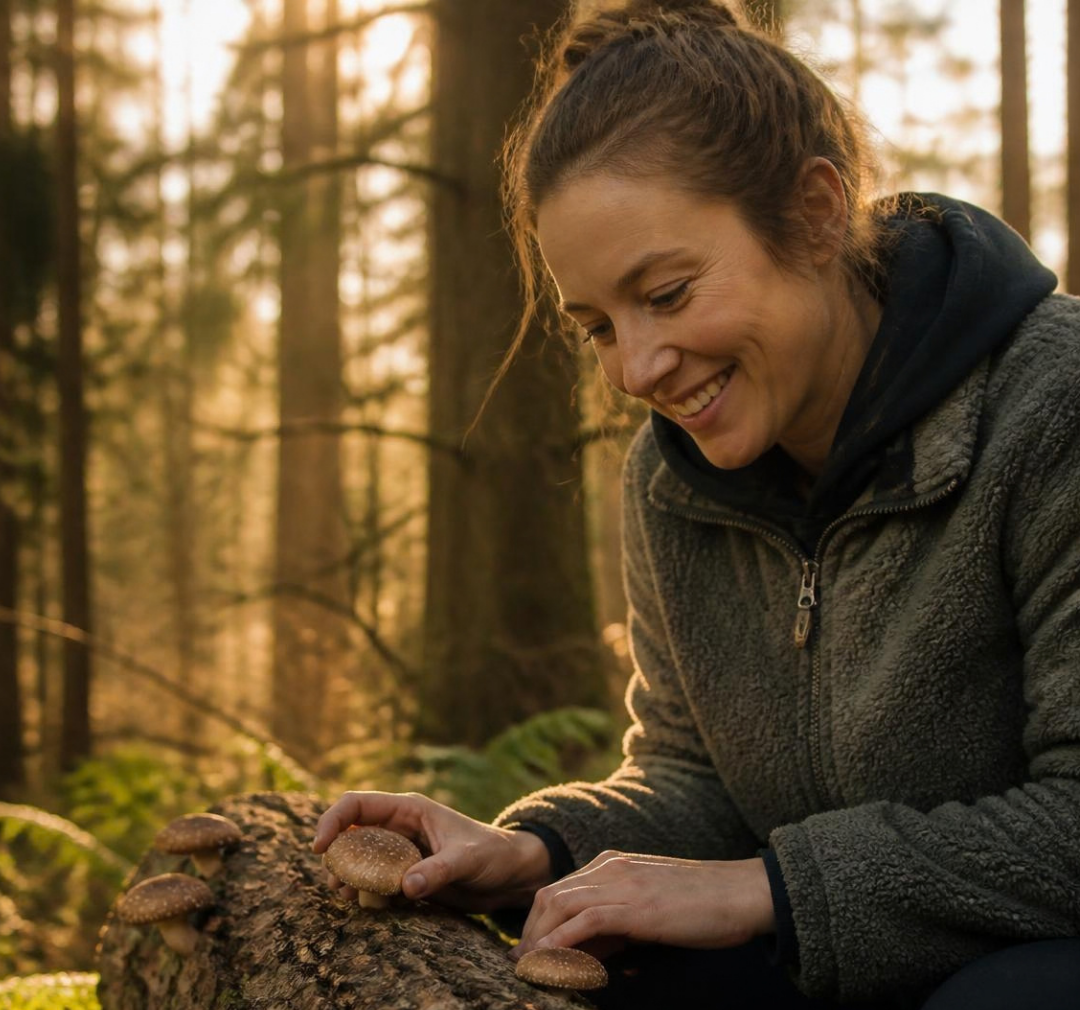
Here's the thing about the "future" of protein: some of it is very old. Growing Shiitake on logs goes back centuries, and people still do it in their backyards. A university extension guide lays out the basics:
- Pick the wood. Freshly cut hardwood, often oak or sugar maple, cut within the last three months. Logs about 4 to 8 inches across and 3 feet long are ideal.
- Drill and plug. Drill small holes in a diamond pattern, 4 to 6 inches apart, and tap in plugs of Shiitake spawn.
- Seal with wax. Melted food-grade wax over each hole keeps competing fungi out.
- Wait. Stack the logs somewhere shady and moist. The mycelium spends months working through the wood. First mushrooms typically show up in 8 to 12 months, and a log can keep fruiting for years.
The future of protein might be growing in a steel tank, or on an oak log in somebody's backyard. Either way, it's growing on fungi.
Why fungi work so well for food
- They grow indoors, all year. Mushrooms and mycelium can be grown in controlled rooms and tanks, so they don't wait on a growing season.
- They grow on humble stuff. Hardwood sawdust, grain and logs are all common things to grow mushrooms on.
- They transform what they touch. That's fermentation, and it's been behind bread, cheese, soy sauce and tempeh for centuries.
- They do more than food. Mycelium is also being grown into packaging, textiles and building materials.
Where MycoProtein fits
MycoProtein is our take on all of this. We start with pea and rice protein, let Shiitake mycelium ferment it, then add Lion's Mane, Reishi, Turkey Tail and Chaga. The result is a complete protein with a PDCAAS score of 1.0, and five mushrooms in every scoop.
Other brands add mushrooms to protein. We ferment protein with mushrooms.
Meet the five in every scoop
Shiitake. The fermenter, and the star of the log above. It makes up roughly a quarter of all the mushrooms grown in the world.
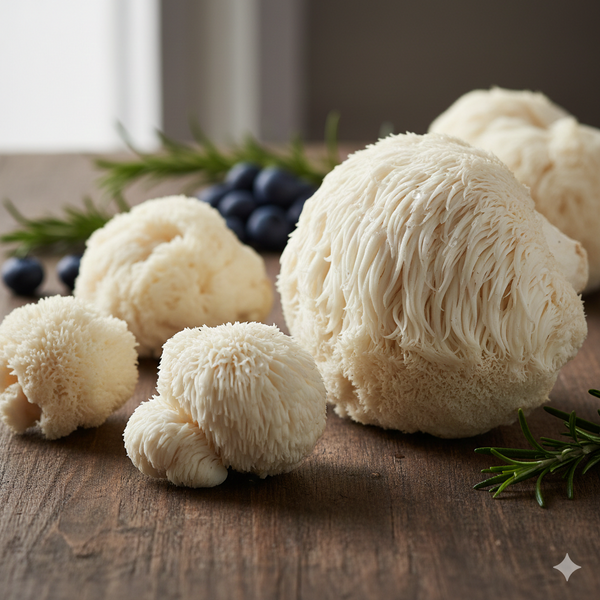
Lion's Mane. No cap, just a waterfall of white spines. More on Lion's Mane.
Reishi. The glossy one that looks lacquered. More in Functional Mushrooms, Explained.
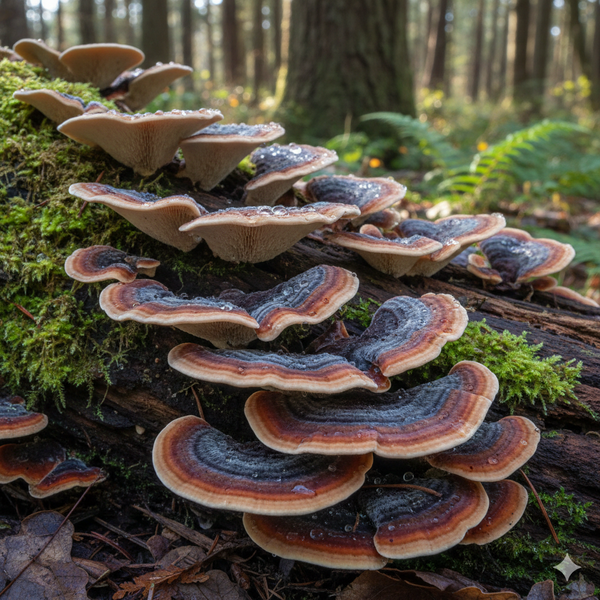
Turkey Tail. Striped caps stacked like shingles on a fallen log. More on Turkey Tail.
Chaga. Our namesake: charcoal-black outside, orange inside. More on Chaga.
What's in a scoop
- 20g of plant protein in Chocolate, 19g in Vanilla, per 2-scoop serving
- A complete protein, with a PDCAAS (Protein Digestibility-Corrected Amino Acid Score) of 1.0, the highest score possible
- Five mushrooms: Shiitake, Lion's Mane, Reishi, Turkey Tail and Chaga, all 100% USA-sourced
- Sweetened only with monk fruit and allulose. No stevia, no sucralose, no added sugar and no artificial sweeteners.
- Vegan, gluten free and non-GMO
Common questions
Is MycoProtein lab-grown meat?
No. Lab-grown (or "cultivated") meat is grown from animal cells. MycoProtein is plant protein fermented with Shiitake mycelium, plus four more mushrooms. No animal cells involved.
Is it made with precision fermentation?
No. We don't use a microbe to produce a single isolated ingredient. A living mushroom culture ferments the protein itself.
If fungi are closer to animals, is MycoProtein still vegan?
Yes. Fungi are their own kingdom, not animals. MycoProtein is vegan, gluten free and non-GMO.
Can I grow Shiitake at home?
Yes. Log kits and plug spawn are widely sold, and many university extension programs publish free how-to guides. Just be patient: the first flush can take most of a year.
Try it
The future tastes a lot like breakfast. A few to start with: Protein Pancakes, Chocolate Overnight Oats, The Smoothest MycoProtein Shake, or browse all our recipes.
Curious how it stacks up against whey, plant and pea protein? See how MycoProtein compares. Want to meet all five mushrooms side by side? Head to Mushroom 101. Ready to try it? Shop MycoProtein in Chocolate or Vanilla.
*These statements have not been evaluated by the Food and Drug Administration. This product is not intended to diagnose, treat, cure, or prevent any disease.